
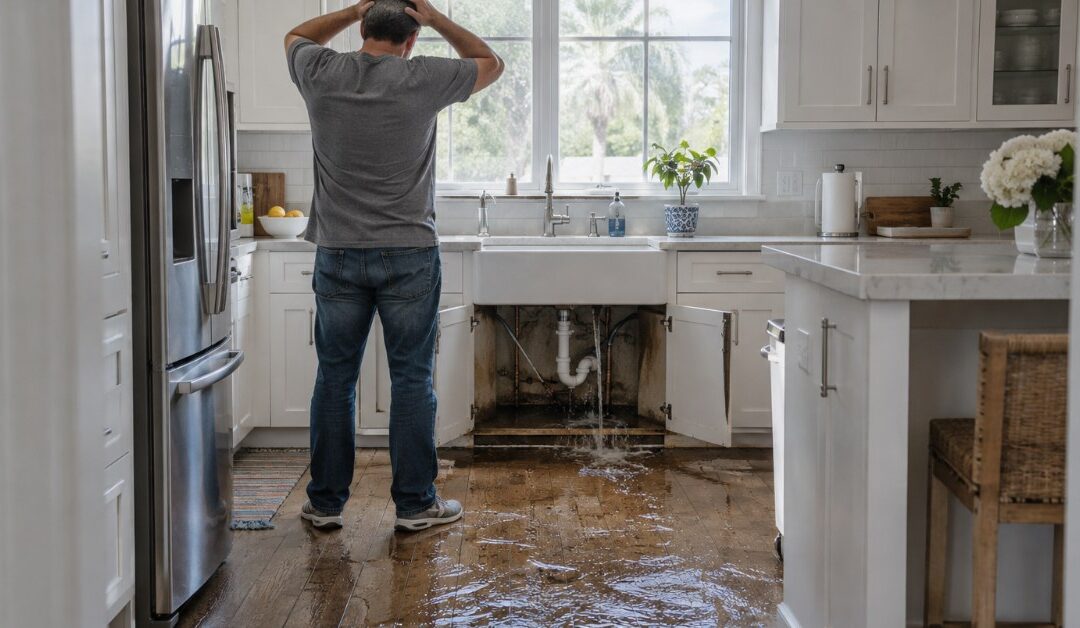
Quick version: most Florida homeowner policies pay for water damage that is sudden and accidental, such as a pipe that bursts. They usually do not pay for damage from a leak that went on for weeks or months. What you do right after you find the water damage matters more than people think.
Edgar Velazquez wrote this page. He holds Florida public adjuster license #P140117 and runs Monarch Claims Consultants in Miami.
Water damage is the most common reason a Florida homeowner calls us. A supply line under the sink breaks. A water heater fails overnight. A stain shows up on the ceiling under an upstairs bathroom. The first question is always the same: is this covered? The honest answer is that it depends on how the water got there, how long it was there, and what your policy says. Some policies limit water damage. Some exclude it. This page walks through all of it.
SUDDEN AND ACCIDENTAL: THE WORDS THAT DECIDE MOST WATER CLAIMS
The standard Florida homeowner policy covers what it calls a sudden and accidental discharge or overflow of water. The water has to come from a plumbing, heating, or air conditioning system, or from a household appliance. A pipe that bursts, a supply hose that splits, a P-trap under the sink that lets go, a water heater tank that fails, a washing machine that overflows. Those are the classic covered events.
What gets paid is the damage the water did. Floors, drywall, cabinets, baseboards, furniture, and the cost to dry the home out. Most policies also pay to tear out and replace the part of the building you have to open to reach the part that failed. If a plumber has to cut a wall to get to the pipe, that wall is usually covered.
What usually does not get paid is the part that failed. The pipe itself, the water heater, the appliance. Most policies say plainly that they do not cover the system or appliance the water escaped from. So the plumber’s bill to replace the fitting is typically yours. The damage the fitting caused is typically the claim.
WHAT GRADUAL MEANS, AND WHY YOU SHOULD NEVER GUESS WHEN A LEAK STARTED
Almost every homeowner policy sold in Florida excludes damage from water that seeped or leaked over a period of weeks or months. A slow drip that ran for a long time is treated as a maintenance problem, not an accident. That is the line between a covered loss and an excluded one, and it turns on one question: when did the leak start?
Here is what most homeowners get wrong. When you find a leak, the insurance company will ask how long it has been going on. You do not know. You are not a plumber, an engineer, or a causation expert, and guessing hurts you. If you say “probably a few weeks,” that guess becomes part of the claim file. Stick to what you know for a fact: the day you found it and what you did about it. If you are asked how long you think it was leaking, the accurate answer is “I just discovered it and took steps to stop it.” As far as your knowledge goes, the day you found the leak is the day it started. Whether it started earlier is a question for an expert with instruments, not for you on the phone.
The same section of most policies also excludes wear and tear, deterioration, rust, and corrosion. Read that carefully, because it is narrower than it sounds. In most policies those words exclude the worn part itself. The water damage that the worn part caused is usually still covered. A corroded fitting that finally opens up is a good example: the fitting is on you, the wet floor and cabinets are usually the claim. Sorting that out is one of the first things a public adjuster does on a water loss.
THE LEAK YOU NEVER SAW
Hidden leaks are the hard cases. A pipe under the slab. A drain line inside a wall. A shower pan that failed behind the tile. You did not see it, so you could not report it, and by the time the floor buckles the leak may have been running for a while.
This is where a public adjuster brings the most value. Before anyone calls the insurance company, we look at the evidence of when the water started: the plumber’s written findings, the moisture readings that show how far the water traveled, and the condition of the materials. We read the water section of your policy, including any hidden water endorsement, and we tell you plainly whether a claim makes sense and how to present it. Many people call the insurance company first, guess at a timeline, and only then find out what their policy says. Do it in the other order.
WHAT TO DO WHEN YOU FIND A LEAK
Florida’s Homeowner Claims Bill of Rights is written into section 627.7142 of Florida law. It tells homeowners to make and document the emergency repairs needed to stop further damage. It says to keep the damaged property if you can, keep every receipt, and take photos or video before and after any repair. That advice is exactly right for water, and here is how to apply it.
Stop the water. Shut the valve or the main. Then photograph everything before you touch it. The wet floor, the ceiling stain, the standing water, the source.
Keep the part that failed. Do not let the plumber take away the split fitting or the corroded elbow. That piece is the proof of what happened and how fast. Put it in a bag and label it.
Get the plumber’s findings in writing. A short invoice that says what failed and what it looked like is worth more than a long conversation nobody wrote down.
Dry the home out. Standing water for days turns a covered loss into a mold problem, and many policies limit what they pay for mold. Keep the drying company’s records.
Report the claim right away. Section 627.70132 of Florida law gives you 1 year from the date of loss to give notice of a new claim, but do not treat that year as time you have. Nearly every policy requires notice as soon as reasonably possible, and the longer a water loss sits unreported, the more room there is to question how long the water was there and whether the damage is from the event you reported. Days matter here, not months. Our page on how long you have to file a property claim in Florida covers every deadline.
FOUND WATER AND NOT SURE WHAT COMES NEXT?
Send us photos of the damage and the source, plus the plumber’s note if you have one. We will tell you, free of charge, whether this looks like a covered loss and what to protect right now.
Get a free water damage review
Or call 1 (888) DAMAGE-0
WATER LIMITS: WHEN THE POLICY CAPS WHAT IT PAYS, OR PAYS NOTHING
Some Florida policies put a dollar limit on water losses that are not caused by weather. The best known example is Citizens Property Insurance. Under its current rules, a nonweather water loss on a Citizens HO-3 or DP-3 policy is subject to a $10,000 limit. The limit does not apply if the homeowner uses the Citizens Managed Repair Contractor Network for the permanent repairs. Citizens also offers a free emergency water removal service. If you hire your own water removal company instead, that cost comes out of the $3,000 emergency measures allowance and reduces the $10,000. Those numbers come from Citizens’ own published answers and were current when this page was written.
Other insurance companies sell water damage limits too, especially on homes with older plumbing, and some policies exclude water damage completely. This happens more often than people think, and most homeowners find out the day they have a water loss. Look at your declarations page for a line that says water damage, and look for any endorsement with the words “limited water” in the title. A public adjuster can help you confirm whether your water coverage is full, capped at $10,000, or missing, and that answer changes what you can claim and how to present it.
WHERE MONARCH FITS ON A WATER CLAIM
Water claims turn on two facts: what caused the water, and how long it ran. Our job is to fix both of those in evidence before the insurance company’s inspection, not after. We photograph the failure point, keep the failed part, map the moisture through the walls and floors with meters, and match what we find to the plumber’s report. Then we write the repair estimate ourselves in professional estimating software. A well documented cause and timeline is what carries a water claim.
We are also plain with people. If a leak ran so long that it no longer qualifies under your policy’s wording, we tell you that up front. What we can do is make sure the covered part of the loss, the sudden part, the tear-out, the drying, is presented completely and on time. If your water claim was already turned down, our guide on what you can do after a claim denial in Florida explains the next steps.
WATER LEAK QUESTIONS WE HEAR FROM FLORIDA HOMEOWNERS
What is considered sudden and accidental water damage?
It is water that escapes without warning from a plumbing, heating, or air conditioning system or from a household appliance. A pipe that bursts, a supply hose that splits, a P-trap under the sink that lets go, or a water heater that fails are the usual examples. Most Florida homeowner policies cover the damage that kind of release causes.
Will home insurance cover a slow leak?
Usually not. Most Florida policies exclude damage from constant or repeated seepage or leakage over a period of weeks or months. Damage from a sudden and accidental release of water is a different event and is usually covered. What matters is not to guess which one you have. If there is any question that the leak may have started before you discovered it, have an expert inspect and help determine when the loss occurred before anything is said to the insurance company.
What type of water damage is not covered by insurance?
Under most Florida homeowner policies, damage from constant or repeated seepage or leakage over weeks or months is not covered. The worn part itself is excluded under wear and tear, deterioration, rust, and corrosion, but in most policies the water damage that part caused is still covered, so do not assume there is no claim because a pipe was old. The pipe or appliance the water came from is usually not covered either. Flood, meaning water that comes from outside the home such as rising water or storm surge, is excluded from the standard homeowner policy and needs a separate flood policy. A public adjuster can tell you which side of each line your loss falls on.
Is a burst pipe covered by homeowners insurance?
Under most Florida homeowner policies, yes. A pipe that bursts is the clearest example of a sudden and accidental discharge of water. The damage it causes to the home and its contents is normally covered, subject to your deductible and any water limit on the policy. The pipe itself is usually not covered.
Does insurance pay to replace the pipe that broke?
Most policies do not pay for the system or appliance the water escaped from. They do pay to tear out and replace the part of the building that had to be opened to reach the pipe. That can be the drywall or a section of the slab. Read the water section of your policy for the exact wording.
What should I say when the insurance company asks how long the leak was going on?
Say what you know for a fact and nothing more. You know the day you found the water and what you did to stop it. You do not know when the leak started, and guessing turns your guess into part of the claim file. A simple, accurate answer is “I just discovered it and took steps to stop it.” If the start date matters, it should come from an expert with instruments, not from an estimate on the phone.
Does homeowners insurance cover a leak under the slab?
It depends on the policy and the facts. The damage caused by a sudden pipe failure under the slab is often covered, along with the cost to break and repair the slab to reach the pipe. Damage from a long running leak may fall under the seepage exclusion. Some policies also handle hidden water damage under their own terms. Get the plumber’s findings in writing and check your policy before deciding.
Why does Citizens limit water damage to $10,000?
Citizens Property Insurance applies a $10,000 limit to nonweather water losses on its HO-3 and DP-3 policies. The limit applies when the homeowner does not use its Managed Repair Contractor Network for permanent repairs. Citizens states that policyholders who use the network can be paid up to the policy limit for the covered repairs. In our experience, many homeowners still take the $10,000 and handle the repairs themselves. Common reasons are wanting to control the work, wanting to use their own contractor, wanting to choose their own materials and timing, and preferring to have the deductible subtracted from a payment rather than paid out of pocket to a contractor. Whether that trade makes sense depends on the size of the loss, and it is worth talking through before you choose. Those are Citizens’ published rules as of the date this page was written, and they can change.
Should I throw away the broken pipe or the wet materials?
No. Keep the failed part and, when you can, the damaged materials until the claim is resolved. Florida’s Homeowner Claims Bill of Rights advises keeping the damaged property, keeping receipts, and taking photos or video before and after emergency repairs. The failed part is the best evidence of what happened and how fast.
Does homeowners insurance cover mold from a leak?
Sometimes, within limits. Many Florida policies cover mold only when it results from a covered water loss, and many cap the amount they pay for mold at a set dollar figure. Drying the home quickly after a leak protects both your health and your claim. Check your policy’s mold section for its limit.
THE CAUSE AND THE TIMELINE DECIDE WATER CLAIMS
Before the insurance company’s inspection, let us document what failed and how far the water went. It costs nothing to ask, and it is much harder to prove after the repairs are done.
1 (888) DAMAGE-0 | (305) 972-2034 (Direct)
This page is general information about water losses under Florida homeowner policies as of the date it was published. It is not legal advice, and it does not decide coverage for any particular loss. Policy wording differs from company to company, so read yours and talk with a licensed professional about your own facts.
Edgar Velazquez, Florida public adjuster license #P140117. Monarch Claims Consultants, Inc., Miami, Florida.
THIS IS A SOLICITATION FOR BUSINESS. IF YOU HAVE HAD A CLAIM FOR AN INSURED PROPERTY LOSS OR DAMAGE AND YOU ARE SATISFIED WITH THE PAYMENT BY YOUR INSURER, YOU MAY DISREGARD THIS ADVERTISEMENT.